Infinite Bloom






We are part of a continuum of existence,
a cycle of lives far greater than ourselves.
Infinite Bloom is a VR exploratory game about non-human ontology and cosmic insignificance. Embody beings from vast cosmos to tiny plankton, and even your mind. Use your hands to flap or swim to navigate unfamiliar worlds through the eyes of other beings. Power, identity, and scale become fluid. Faced with the vastness of the world, human is only a drop in the ocean, part of a continuum of life far greater than us.
Wishlist now!
Created by
Kora Lee: Producer, Creative Director, Programmer
Thao Tran: Art Director, 3D Artist
Doris Huang: 2D Artist, UI/UX Designer



Gestural Interactions
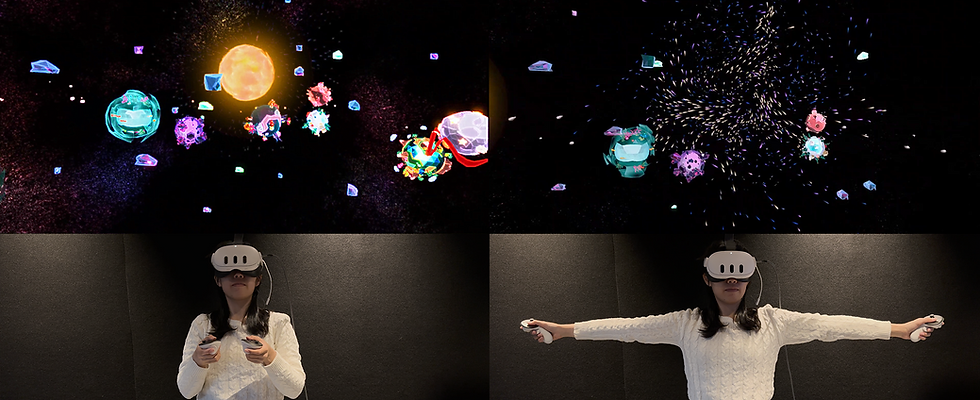
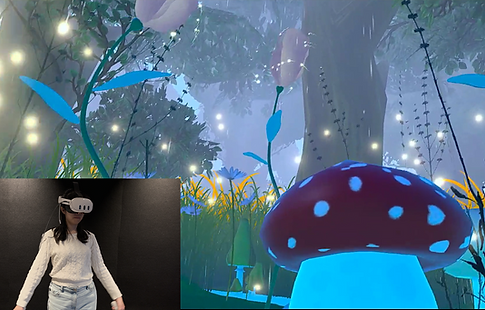
Use your body to experience life as different non-human beings. Embody the gigantic cosmic entity to throw the planets, or spread your arms to alter the flow of comets and stars. As the journey continues, you gradually shrink into smaller beings. You may flap your arms as a tiny insect to fly through the sunlit garden, or drift as a glowing plankton to illuminate the depths of the ocean. Finally, submerge within and swim through your consciousness space. Step into Infinite Bloom and reveal the vastness of this world.
Game Pillars

Explore and Discover!
• Enjoy the mind-opening journey that reveals just how small humans are in this amazing, vast world
• You may even dive deep into your own subconscious?!

Use Your Body to Play
• Fly, swim, and move to immerse in the perspectives of various creatures.
• Feel the power and effort through gestural interactions designed based on power pose theory and Labanotation.

Become Anything beyond Human
• See the world through the eyes of everything, from a powerful cosmic entity to a tiny plankton.
• Shrink into smaller forms with reduced agency to shift away from self-centredness and feel humble.


Universe
• Spread your arms wide to alter the comets' movement
• Grab and throw planets freely

Subconscious
• Swim through your subconscious and revisit the memories of the previous worlds
• Dive back into the universe to complete the cycle of life
Player Experience
Island
• Rain over the barren land to revive the island.
• Hear animals sing in response to your moving rainclouds.


Sea
• Touch and push the bioluminescent plankton to light up the water
• Restore life to the ocean.
Garden
• Flap your arms to fly through the garden
• Pollinate flowers before the storm arrives
Devlog Video
Devlog 1: The Flying Experience
Problem: In the garden world, players fly as a butterfly by flapping their arms. However, the initial flying felt rigid, and having to keep flapping to stay in the air quickly made players' arms tired, pulling them out of the experience.
Solution: To make flying more enjoyable and less physically demanding, I remapped the flying speed using an exponential curve, so the movement responds more smoothly and naturally to players' flapping. I also added a gliding feature: players can simply open their arms to glide slowly through the garden, giving them a chance to rest while still exploring. The drop speed while gliding was fine-tuned over several rounds of playtesting to minimise motion sickness.
Outcome: Flying became smoother, more relaxing and comfortable, letting players enjoy the garden at their own pace instead of focusing on the effort of staying in the air.


Devlog 2: The Garden Level Design
Problem: In the garden world, players were unsure what actions to take or where to go. They lacked clear guidance on their goal: to experience life as a butterfly, pollinate flowers and fly to the portal.
Solution: Text instructions and progress bars were options, but since our core pillars were exploration and player freedom, I was hesitant to use them. I later realised that what matters isn't whether we use guidance, but how it is presented. Instead of giving instructions, I framed guidance as open-ended questions players might ask themselves, such as "Who am I in this world?" and "Where are the other butterflies going?" A famous philosophical quote from Alan Watts at the start of the game also sets up the idea behind the journey, inviting players to reflect.
In VR, players tend to explore more cautiously than in PC games, as they are still getting used to moving through a virtual space. To lead them along the flower path towards the portal, the original circular path was updated to an S-shape.
During playtests, players loved flying over to the butterflies resting on the mushrooms, saying "Hello, my butterfly friends!" Building on this, I placed butterflies on the flowers along the path as visual cues, and added a flying tutorial graphic that appears if players haven't moved after a few seconds.
Outcome: Players flew closer and engaged with their butterfly companions, feeling part of a community. Reusing existing 3D assets also kept us within our timeline and budget.
Devlog 3: Wiggle in the Rain!
Problem: In the island world, players become the sky, overlooking the island. In the original design, players pointed at animals to make them call out, but this interaction felt too plain.
Solution: The idea for for something better came from a happy accident. While building the island, we forgot to turn on gravity, and the chicken and tiger floated up into the sky. Watching these poor animals drift away was so funny that it made us wonder: what if players could play with the animals more directly?
I replaced the pointing mechanic with a more playful interaction: players can squeeze the rain clouds above the island to shower the animals below. The animals wiggle in the rain!
However, playtests revealed a new issue: players paid more attention to the animals than to the clouds, so they often missed grabbing the clouds to make it rain. To draw their attention to the clouds first, I removed the animals at the start. Now, when players make it rain over the island, trees begin to grow, and animals then jump onto the island playfully, ready to be rained on!
Outcome: Players always laughed when they saw the animals wiggling in the rain, and felt even happier seeing that they were bringing the island to life. This world became one of the most popular stages in the game.
Devlog 4: Answering Players' Curiosity!
Problem: In the subconscious world, players swim deep into their own subconscious, surrounded by memories from their journey: the planets, animals and flowers from earlier worlds. We noticed players instinctively reaching out to touch these objects, a behaviour we hadn't originally designed for, and I saw it as an opportunity.
Solution: I added touch and proximity interactions to reward this curiosity. When touched, the tiger looks around and roars, the flowers bloom, and the DNA bounces with a heartbeat sound. Shiny particles swirl through the space, then gather into clear shapes of planets, animals and flowers as players swim closer.
Outcome: Many players enjoyed floating inside the swirling particles, curious to find out what it feels like to be inside a flower made of light. Some also said they felt connected when touching the DNA and seeing it pulse in their palm.
Devlog 5: Performance Optimisation
Problem: The memories in this world come alive when touched, driven by each object's Animator component. However, every Animator kept running in the background, using up CPU and slowing the game down. To create a dreamy atmosphere, we also used SDF VFX particles with an additive URP Lit Mesh output, which greatly increased the GPU workload. Together, these lowered the frame rate. This mattered especially because standalone VR headsets run on mobile Android hardware with limited processing power, and a stable frame rate is essential for player comfort in VR.
Solution: I used camera-frustum visibility checks to switch off Animators when objects are outside the player's view, and reduced the number of particles based on the player's distance from each effect.
Outcome: This removed unnecessary CPU and GPU work from animations and distant particles, while keeping the full visual quality when players are interacting with or viewing the effects up close. The frame rate improved significantly.
Particles gather into clearer shapes as players swim closer, and drift in a turbulent swirl from afar.
Objects outside the player's view have their Mesh Renderer and Animator turned off to save performance.
Market Analysis
The current VR market focuses on a human-centred perspective, but its potential for immersive, embodied experiences is still underexplored. There's a gap for games where players take on non-human, disempowered roles. This inspired the development of Infinite Bloom, where players shrink into smaller forms with decreasing agency to explore cosmic insignificance.

Personas
Curious Charlie

Generation: Alpha
Habits: After school and weekends, around 1 hour.
Points of Interest: Lighthearted, easy-to-understand, fun
Value Proposition:
• Sparks curiosity by letting players embody butterflies etc.
• Offers engaging and intriguing flying and swimming experiences
Hardcore Henry

Generation: Gen Z
Habits: 2-3 hours every day after work consistently.
Points of Interest: Creative VR experiences, new mechanics
Value Proposition:
• Discover unique ways to interact through gestures.
• Rewards exploration through gameplay feedback.
Relaxing Rachel

Generation: Gen Y
Habits: Once a week, short play sessions.
Points of Interest: Reflective, artistic, and relaxing experience
Value Proposition:
• Immerses in the calm, awe-inspiring environments.
• Deliver inspiring and meaningful moments with emotional depth